Showing posts with label Food. Show all posts

Saturday, 29 December 2012

Chelsea Buns for Christmas!


I was devastated last year when I visited Cambridge and found Fitzbillies bakery closed for business. Then Tim Hayward and Alison Wright came to its rescue and Fitzbillies, that most Cambridge of institutions, are selling their wondrous Chelsea buns again, along with – extra bonus – slices of their incredible Sachertorte cake! (So you don't have to buy a whole cake.) Others are rapturing about the delicious menus in the new café-restaurant, but I am just glad for the take-aways.
   Yes, we fell in love with Fitzbillies Chelsea buns during our time in Cambridge but are somewhat glad we don't have access to them too often anymore. They are very special food, and so what did we eat this past Christmas day? Not turkey like every other household in Britain but Chelsea buns! What a treat.
   As for the Sachertorte, having loved the Fitzbillies variety, we were very excited one year to be in Vienna to visit the Sacher Hotel, which made the cake famous. With watering mouths, we ordered our Sachertorte – and, it didn't hold a candle to Fitzbillies' version!
   You can read all about the excitement of the new opening of Fitzbillies this past autumn and their various offerings on their website. And if you can't get to Cambridge to try these delicacies, both Chelsea buns and Sachertorte are available by mail order. Enjoy!

Wednesday, 12 September 2012

Bone marrow at the Court Restaurant, British Museum

The Court Restaurant is a classy place to eat lunch at the British Museum. Situated high up in the Great Court, you get good views of the wonderful geometric glass ceiling over the court and can see the clouds beyond. Because there are two coffee shops in the court below, the buzz of conversation from there is a little diverting, but the restaurant's tablecloth settings, including a live miniature chili plant (with chilis) instead of flowers, give a fancy ambience. For those pleasures, the menu is stiff: ca. £22 for a 2-course or £28 for a 3-course meal. But a la carte held some surprises.

Bone Marrow at the Court Restaurant, British Museum
In the past month, I have seen three references to bone marrow on menus. Where has this come from suddenly?? I suppose bone marrow is consistent with the traditional down-market English cuisine of whelks, steak & kidney pie, tongue and tripe, etc. I first ate it (trepidatiously) mixed in with mashed potatoes. Wonderful! What a flavour. So yesterday at the British Museum, I thought I'd try the Small Plate meal of Bone Marrow (£6.50, not a bad price for lunch).

What did I get? Four halves of a long bone and three slices of baguette. I needed more baguette! The stuff was so rich I could only eat one and a half of the bone contents, sharing an equal amount with my co-diners. That took care of the three baguette slices and left one bone contents uneaten. So I asked to take all the bones home with me (of course, the waitress thought it was for a dog, but it was really for my husband to try, on a rice cracker).

How was it? Well, straight from the bone, it wasn't as tasty as the mashed potatoes. It might have been better if I had loaded the seasoned salad garnish with sea salt onto the bread as well. In making my open-face sandwich, it was hard to spread the marrow. It has the consistency of jello (English jelly) and tends to wobble around a lot and fall off the bread. It looked kind of greyey pink, somewhat like a pink speckled jelly bean. And I felt like a Stone Age carnivore eating it.

Would I try it again? Yes, for the novelty and to see if the flavour changes with different ways of cooking and presenting it. It was a great conversation piece over lunch and cost a quarter of what the others paid. So, see you at the Court Restaurant for a real experience!

Sunday, 12 August 2012

Mackerel: sky over Durham and fish in my fridge

Mackerel Sky
Lamb or Sheep clouds
Thursday we had a spectacular mackerel sky in Durham, where I took these pictures, that lasted for at least an hour. So unusual for England, where heavy undistinguished clouds are more the norm. Lots of people I talk to don't know what a mackerel sky is, so I looked it up on Weatheronline to provide more information. They are high clouds, forming between 6-10,000 m (20-33,000 ft). High winds disrupts cloud formation to make them streaky or puffy: the former look like stripes on a mackerel, the latter look like sheep. And indeed, these sheepy clouds are called schaefchenwolken in German (lamb clouds) and nuages moutonneux in French (sheep clouds).
    I always learned that high clouds don't rain, but Weatheronline says that a mackerel sky foretells rainy weather and storms, as any sailor or fisherman can tell you. It forms about 400km in advance of the rainy patch. Sure enough, Friday was cloudy with some pretty dark ones up there.
Smoked mackerel & banana
   Despite the rarity of mackerel sky, England can lay claim to some other, pretty nice kinds of mackerel:  honey-smoked mackerel, smoked peppered mackerel, even chili smoked mackerel. These are filets sold vacuum packed in supermarkets and are the perfect quick food, hot or cold. They can be mixed with cream cheese to form a tasty dip, or I like to eat them stirred into a ripe mashed banana. How disgusting, you might think, but a friend says it is a common food in places like Madagascar. Well, I've never been to Madagascar, but a trip there to see the birds and eat mackerel/banana sounds just the thing.
Mackerel sky over Durham
   When spending long spells in other countries, I really miss smoked mackerel – it's such a cheap and plentiful fish, I'm surprised more places haven't taken up this way to serve it. Personally, I don't like cooked fresh mackerel (too fishy) and can't think of anything much more repulsive than tinned mackerel like they sell in the States (well, maybe tinned pilchards are worse). Anyway, with the push to eat more Omega 3s, think of the lowly mackerel, with or without the banana!

Thursday, 9 August 2012

What is a bacon buttie?

It used to puzzzle me, not so much the bacon but the 'buttie', or 'butty' as it is more often spelled. The Oxford Dictionary says it is a sandwich that derives from 'butter', and the word seems to be used only for hot fillings. So the sandwich filling of a bacon buttie is bacon, but what is the bread called? Up Durham way: a 'bap', of course, or a 'stottie/stotty'. Baps are soft like hamburger buns but they can grow very big, like 6" across; stotties are more dense and heavy, made as 12" cakes. Tremendous differences across England in naming these kinds of bread, though.
Bacon at St Lawrence market, Toronto
streaky bacon on left, peameal slices in
middle, peameal bacon loaves on right
   So, a bacon buttie is a bacon sandwich. The filling? Bacon – what Americans would call 'Canadian bacon' (made from pork loin), more solid than normal bacon which the English call 'streaky bacon' (made from pork belly) and the Canadians call 'side bacon'. The Canadians themselves have 'peameal bacon', so named because the log of pork loin meat is rolled in ground dried peas; when sliced, the bacon pieces have a rim or crust of peameal. Because of its excellent preservative qualities, this kind of bacon was apparently the biggest Canadian contribution to England during the war; it was called 'lorry' or 'boot' bacon because of its transportability.
   I learned all this from our trip to Toronto recently where we ate peameal bacon sandwiches at the St. Lawrence market (highly recommended to us). And upon returning to England, I decided it was high time I tried a bacon buttie, which I had been avoiding all these years. Rather than being disgusting (because all there is is bacon, butter and bread), it was actually very very tasty, probably due to the six kinds of umami in bacon which are thought to be addictive (see the Wikipedia article on 'bacon' – very informative!). Apparently bacon sandwiches were a favourite food of Fergie (the Duchess, not the footballer) before she went on her various diets. And they are ubiquitous in England – many people eat these for breakfast on the run.
   So how do bacon butties compare with peameal bacon sandwiches, and BLTs for that matter? Though sparsely appointed, a bacon buttie goes down very smoothly, while I struggled to finish even one half of my peameal bacon sandwich (had to take the other half away) because it was so stuffed with 8 layers of bacon. I presume the peameal bacon and BLT (bacon, lettuce and tomato) sandwiches are better for your health because they at least have some vegies in them, and the latter can be made with wholemeal bread. But I must say, that bacon buttie was sure tasty, probably because it was hot bacon and had more fat in it than the cold peameal bacon sammie. (The British Sandwich Association gives an annual Sammie Award; maybe I should nominate the bacon buttie.) Now converted, I'll have to try not to make them a habit. Maybe a 'chip butty' is next.

The Toronto peameal bacon sandwich
from Oink, St Lawrence Market
Bacon buttie at the Dun Cow in Durham
 served 11-2, Mon–Thurs

Tuesday, 14 February 2012

Valentine's Day 'stay-in'

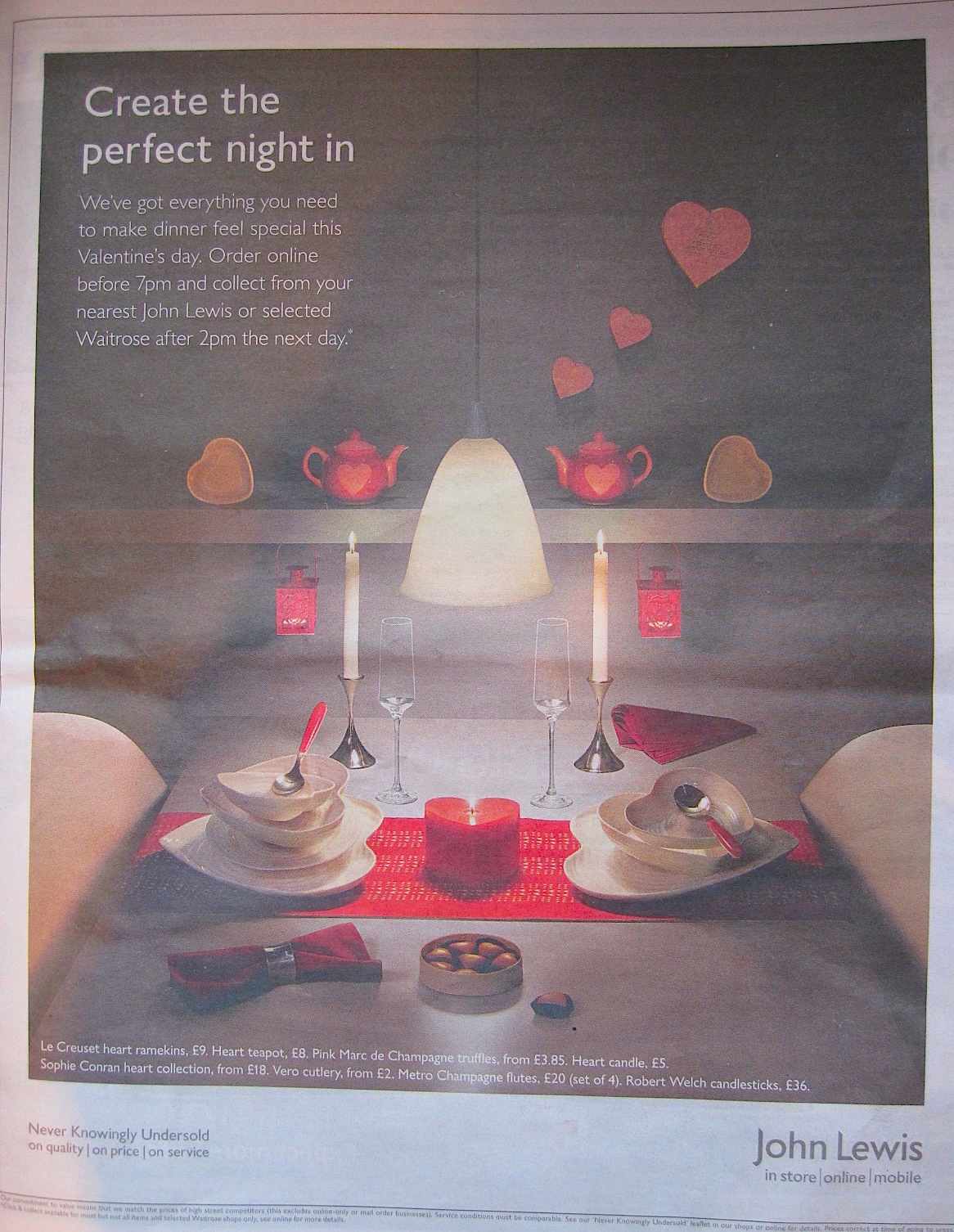
So what are you doing today? Going out and shooting your wad? Or staying in and eating gourmet? Both John Lewis and Waitrose, not surprisingly, are pushing the latter. Spend your money here, say their ads. The supermarket Waitrose offers "Dinner for two: Starter + Main course + 2 Side dishes + Dessert + Wine or fizz" for £20. Now, that's worth considering any day! And John Lewis (the staff-owned department store) will set the table for you: "We've got everything you need to make dinner feel special this Valentine's day."

At first I thought a stay-in fancy dinner is like a stay-cation, a new type of British holiday promoted since the banking crisis started, to stay in Britain rather than go abroad for a vacation. But at least a stay-cation has the advantage of eating breakfast in someone else's house (B&B); staying home for dinner doesn't much cut it, especially if all the food is bought in.

Just cook me a nice stand-up lasagne from scratch and I'll be happy....But actually, we are going out for our Valentine's Dinner on Saturday, so I'll report back on it then.

Friday, 13 January 2012

Runner beans, are they or are they not?


It's time to think of planting a garden this summer! But what varieties? Above are the "runner beans" planted by my sister in the States. I was there at harvest time and took these pics of the bean pods (left, curved, 5-7 inches in length) with the beans clearly showing, and the black* and white beans that had already been shelled. The beans were productive, but they were not the runner beans I know from England.

English runner beans are long (ca. 10 inches), straight, and bean-less. It's the pods that are eaten: boiled or steamed al dente, the pods are absolutely delicious – one of our most favourite vegetables and available only in the winter after harvest.

Curious about the difference, I first investigated the English runners: I went to Homebase to see what they were selling for planting this spring: runner bean varieties Armstrong, Polestar, Prizewinner, White Lady and Scarlet Emperor. Then I went to the UK Suttons Seeds website and found that their catalog has 41 entries under "runner beans", and most of the pictures look like the English version, whatever the variety.

So why are American runner beans different? What is their variety? All runner beans here and there are of the species Phaseolus coccineus, so the variety is really important. How can the English varieties be bought there? So sad to think that most Americans might not have tasted the most exquisite vegetable of England.

The American Burpee Seed catalog DOES have the runner bean variety Painted Lady in their Heirlooms category, but they market it as an ornamental. If you let the pods mature, it says they have "pinkish-brown streaked beans" – nothing like the blackish and white beans shown above. In the corner of the Suttons Painted Lady marketing picture, you can see a serving suggestion of the cut pods and unformed beans. So Painted Lady must be the best choice for having English runner beans in America. Order from Burpees!

* actually dark lavender with black mottles


Monday, 9 January 2012

Jelly, Jell-o and Jam

So we were talking about sandwiches with friends (have you noticed how many of these blogs focus on food? So much of culture resides in cuisine!*). I was telling them about the good toasted cheese sammys we had at the Northumberland Cheese Farm café on a recent visit (just north of the Newcastle airport for those who want to go). In the States, of course, we call these "grilled cheese sandwiches"; here they are called "toasties".

And then I asked, have you ever tried grilled peanut butter and jelly sandwiches? Their immediate reaction was "yewuuuuuu" because they were thinking jelly = jell-o! Now I admit, a peanut butter and jell-o sandwich would be pretty weird, especially if toasted (runny). (But then think of Kinsey Millhone of Santa Teresa,** who eats peanut butter and pickle sandwiches!)

A doormat produced by the Jell-o company as a pun
on its product name: in different color letters to
represent the flavors of the gelatin dessert
Language lesson:

American "jelly" = jam without the chunky parts

British "jelly" = American jell-o (gelatin)

But isn't there such a thing as jam without the chunky parts in England? Why yes, it's called "jelly" of all things: red current jelly, cranberry jelly, mint jelly, sweet chilli jelly, and bramble jelly (from the Tesco list). It turns out that the first three are considered savoury condiments and used quite differently from jam or American sweet jelly. Bramble jelly is sweet jelly like American jelly; seems it is the only one made as jelly rather than jam because the fruit is so intractable.

American English seems more precise because we have three different terms to differentiate jam, jelly and jell-o, while the English terms jam and jelly have to cover all three products. In both cases though, 'jelly' has to cover two different products: American jelly both sweet and savoury, and British jelly both gelatin and savoury jelly. This explanation rather goes beyond the 3-year-old discussion of these terms on Yahoo Answers, which is difficult to understand anyway because you don't know the nationality of who is answering.

To confuse things further, like American jelly beans (sweet), the English have expanded the term "jelly" to cover jelly babies, snakes, tots and squirms (sweet),  the candies called "jellies" (sweet), and the jelly used in cat food (savoury).

In retrospect, why did my friends immediately think of jell-o in a sandwich rather than bramble jelly, for example? Hmmm, sounds good. In fact, all the savoury jellys sound good. Must try them in peanut butter and jelly toasties...

* As Lévi-Strauss knew when he wrote "The Raw and the Cooked".
** Sue Grafton's private detective in her 'alphabet murder' novels. The story goes that Grafton hated her husband so much on their divorce that she decided to kill him, 26 times through the alphabet in her novels.

Thursday, 5 January 2012

Lasagne in England & America


English-style lasagne: it might as well be tomato soup!
Why is it that restaurant (Italian or otherwise) lasagne is always soupy? I ordered some recently in an Italian restaurant, hoping that I would get real Italian lasagne, which would stand up instead of swim...I could hardly even find any pasta in this one.


So for comparison, I made lasagne with my mother's recipe (who is Swedish, not Italian), and presto! It stands up all by itself on a plate! It has two layers of pasta, but next time I will make it with three layers. A cinch these days using pasta that doesn't need pre-cooking. 
American-style Italian lasagne that has character and posture

Tuesday, 3 January 2012

Tea, Scones and a Film

So, back to normal (except for Scotland where they're still in Hogmanay holiday). Most people are working, but we took advantage of the reinstated "Golden Days" showing at the Gala Cinema in Durham. Since the cinema is run by the County Council, after taking over from a dead useless entertainment company, OAPs are supported in their recreational needs. (OAP stands for Old Age Pensioner – meaning anyone over 60, a politically impolite appellation if I ever saw one.)

Golden Days showings are Tuesdays at 11.30am; this week was "Mission Impossible", just what OAPs want: to be reminded that they are no longer so young and active. But the real draw is, in addition to cheap tickets, free tea or coffee and a scone (sweet or cheese) beforehand.
Sweet scone with raisins on left, cheese scone on right

Scones were unknown to me before coming to England, but we do have baking powder biscuits in America. So what's the difference? Well, I finally found two recipes to compare:

SCONES
3 cups of flour
3 tsp baking powder (or more)
1/2 tsp salt
1~2 TBSP butter
milk to mix
AND THEN add raisins (optional) and 1/4 cup sugar for sweet scones
OR 4~6 TBSP grated cheddar and 1/4 tsp cayenne for cheese scones

BAKING POWDER BISCUITS
3 cups of flour
4 tsp baking powder
1 tsp salt
6 TBSP shortening
1 cup of milk

So, scones are just baking powder biscuits with additions to make them sweet or cheesy. The biscuits themselves are savoury, to be eaten with dinner, while scones are a snack. I don't think anyone would eat a baking powder biscuit as a snack unless they were really hard up; they are dinner items.

In any case, it's pretty nice of the Durham County Council to supply scones rather than biscuits – that is British 'biscuits', i.e. 'cookies'. Are you confused now?

Sunday, 25 December 2011

Brussels sprouts tree for Christmas

Without a Christmas tree this year, we thought we'd splurge on a Brussels sprouts tree (£1.00). Yes, that's what Sainsbury's calls it. Not really a tree though, just a very hefty stalk for growing all those little sprouts (stalk more than an inch in diameter according to the ruler, ahem 'straight edge'). You didn't know they grew that way? Neither did we until Christmas in England.

Every Christmas, the supermarkets bring on their sprouts for that special turkey dinner. And of course, they have to be something special themselves, hence the stalks. The Guardian Weekend yesterday featured a UK farm that produces 210 million sprouts a year, and that's just a 250-acre farm. So we can assume a people eat a lot of them.

I like mine steamed with flaked almonds and then seasoned with balsamic vinegar dressing. Someone else suggested cooking them with leeks, or with walnuts. I didn't know you could eat them raw, too; but then, they're just little cabbages. But whatever you do, don't overcook them, says Yasmin.

Yasmin, head of quality control (or "chief sprout taster") on said farm, says they grow twelve different varieties and her favourite is Maximus. This is all well and good, but if the variety name is not on the supermarket package, then how can we choose the small & sweet ones, or the dark & nutty ones?

One comment on the name, too. Is it Brussels or Brussel? Google gives 1.64 million returns for Brussels plural, 1.47 million for Brussel singular (but this includes a lot of plural references). Both Wikipedia and the BBC have mixed entries, the BBC calling them singular in one place but plural in another, while Wikipedia entitles their entry sprout singular. Since Belgium was the hub of production for Europe in premodern times, the name Brussels is most likely correct, but I usually say Brusselsprouts (one word) myself.

Thirty years ago sprouts and winter greens were the only non-root vegetables you could get in England in the winter. How the world has changed since then...but the English still like their sprouts! Happy Christmas!

Tuesday, 13 December 2011

Tinned pumpkin at Waitrose!!!

Look what I have found at Waitrose in London: tinned (canned) pumpkin for pie filling! I bought both existing cans off the shelf, and their "best before" date is October 2014, which means I can make pumpkin pies for Thanksgiving for the next two years!

Libby's is a Nestlé brand, sold throughout the United States and imported and distributed to England by GFT Retail (UK) Ltd. Their address is PO Box 477, Walton on Thames, KT12 5XE, but if you want to "correspond", they guide you to Nestlé's Consumer Services at PO Box 207, York YO91 1XY. Perhaps if the tinned pumpkin isn't sold in your area, you could convince one of these companies to send you a care package.

Since the English traditionally eat turkey at Christmas (not having anything to be thankful for in November), perhaps pumpkin pie could be instituted as a third choice dessert alongside the cloying Christmas pudding and Christmas cake (heavy with dried fruit, icing or sauce and liquor). For those who don't like fruitcake, the pie might be a light option.

The can label has the pie recipe modified for English measures and oven temperatures. Inside the label are three more recipes: for pecan pumpkin sauce, good morning pumpkin pancakes, and pumpkin apple streusel muffins. Perhaps worth experimenting...but only if you have a good supply of pumpkin! See http://gleeb-livinginengland.blogspot.co.uk/2011/11/make-pumpkin-pie.html

Sunday, 27 November 2011

Corn, Beans & Squash: a vegetarian Thanksgiving

Yesterday (Saturday) saw us celebrating Thanksgiving; since Thursday is not a holiday here in England, the dinner usually happens on the weekend. And since we invited vegetarian friends, we had to think up a menu that didn't include turkey. What's Thanksgiving without a turkey, you might ask? Well, how about the original pilgrim menu...

As I heard it in my youth, after many years and months trying to get to the Americas, the pilgrims finally landed on our eastern shores just in time for winter. Not having been able to farm and hunt beforehand to build up winter stocks, they were starving! Native Americans came to the rescue with their staples of corn, beans & squash, and a couple of wild turkeys thrown in for good measure. Ever since, the turkey has overshadowed the triumvirate of good complementary vegetable proteins.

Corn, of course, is the native English word for grain and includes wheat, barley, rye, oats – cereals that can be ground for flour. This is why many English towns have a Corn Exchange building where grains were once brought to market. So when the pilgrims saw Zea mays (named after the Taino Indian word, mahiz or maisí), they must have thought, Oh, this is American corn. While in England, if one wants to be perfectly clear you are talking about Zea mays, you should use the word "maize" rather than "corn", although the Brits do refer to corn-on-the-cob as "sweet corn".
Sorry, I'd eaten most of my cornbread when I decided to
take this picture!

In any case, our menu included both corn-on-the-cob (boiled in water for 20 minutes, eaten with butter and salt), and cornbread. Now the latter was a problem because coarse-ground cornmeal is not normally sold in England. They have "corn flour", which is our "corn starch", and they also unaccountably stock masa harina – fine-ground maize for making corn tortillas. I say unaccountably because the El Paso brand of ready prepared Mexican foodstuffs is very popular here, so why is anyone making corn tortillas from scratch? The American cornbread has definitely not caught on here – I wonder why not since it's soooo good served warm, lathered with butter.
 
To complement the corn, I made vegetarian Boston Baked Beans (what could be more tasty with its infusions of maple syrup, spiced rum and molasses?). Navy beans not being sold here, I used cannellini beans, which are way bigger than navy beans though they are both Phaseolus vulgaris L.; next time I will try haricot beans, another P. vulgaris variety. For dessert, pumpkin pie, classified as a "sweet pie" and served a la mode of course. The latter also caused problems because, not being a pastry chef, I prefer to buy frozen pie shells, but there were none to be had in the supermarkets. So I thought, graham cracker crust is a good substitute, but graham crackers aren't sold here either. Finally I found a recipe that substituted ginger snaps! These they do have here but are called "ginger nuts" or "ginger crinkles". To compensate, I left out the ginger from the pie filling recipe, and the combination of pumpkin and ginger snaps was really good!

Our English dinner guests very much liked the offerings to the extent that the cornbread recipe was shared and taken home. I hope they can find coarse-ground cornmeal somewhere down the line as it makes a lighter, more crumbly bread than the dense masa harina product.

Friday, 25 November 2011

Pie: meat or sweet?

The menu said "pie and salad", which didn't strike a chord with me. If it had said "salad and pie", then I would have thought lunch and dessert. But in fact, the word "pie" in England refers mainly to meat pie, like pork pies, steak & kidney pies, while fruit pies are usually called "tarts" and are rarely as big as American pies.

So I was very surprised to see, in my local coffee shop this afternoon, both kinds of pies being offered:  corned beef pie and steak pie next to apple pie and cherry pie – all so labeled. The "sweet pies", as the lady behind the counter called them, were as large and luscious looking as real American double-crust pies (but no ice cream was offered).
Pies were an East/Southeast London staple the last two centuries. We were first introduced to them at Goddards in Greenwich, the oldest pie & mash business in England. Jellied eel was one of the first dishes created (eat at your own risk), with other meats added as the population became better off. Individual pies were the order of the day, with one or two on a plate accompanied by mashed potatoes (mash) and parsley sauce (liquor). So few of these shops remain that they are being documented (for example, in the blog on Spitalfields Life).

These days, there is even a chain called Square Pie that serves decent meat pies (at least to my tastebuds); but the chain's upmarket furnishings are a far cry from the tiled walls, stone floors, and utilitarian chairs and tables of traditional pie & mash shops. Lastly, both individual and large meat pies can be bought at the supermarket deli, the latter sold by slice as well. We like the turkey and cranberry pie – Ach! Should have had one yesterday for Thanksgiving but never thought of it...At least they're available all year 'round.

Brits are so unacquainted with fruit pies ("sweet pies" rather than tarts) that I had to insist that a group I was on tour with in Arizona made a special stop at a quaint log-built roadside restaurant that advertised thirteen kinds of pie (with ice cream). The group's choices were interesting: tending more to berry fillings (like the fruit tarts they are acquainted with here), and few actually ordered pie a la mode (i.e. with ice cream). But us two Americans in the group knew how to do it and filled up on our favourites with loads of you-know-what on the side!

Monday, 14 November 2011

Make a Pumpkin Pie!


What to do with that old Halloween pumpkin? Make pumpkin pie, of course! It’s one of the seasonal, sentimental foods that Americans really miss in England. And since they don’t routinely sell tinned (canned) pumpkin pie filling in the supermarkets, that means you have to make your own filling.

This was a cooking pumpkin: walls 3" thick!
Hardest part is actually cutting up the pumpkin. I used a whole pumpkin (not with a funny face) that is particularly bred for pie – like Bramley apples are specifically cooking apples that are great in apple pie. It was really a tough pumpkin, three inches thick in places. I had to use a hatchet to break it open. And you can see from the picture that I made two half-hearted attempts with the hatchet that only sliced off conchoidal disks from the surface. The third try went straight in.

After cutting up the pumpkin and scooping out the seeds, separate the seeds as much as possible from the fibers. Spread the seeds for roasting on a flat baking tray and coat with salad oil. Bake the pumpkin pieces in the oven at 350° for 1.5 hours. The seeds can be started with the pumpkin, but they must be stirred occasionally and not allowed to burn, taking much less time to roast than the pumpkin.

Once baked, the pulp can easily be scooped from the skin (peeling a pumpkin beforehand with a vegetable peeler is a thankless and usually unsuccessful task). Use at least an 8-inch diameter pumpkin for 1.5 to 2 8-oz cups of pulp. The following recipe is in American measures:

Take 2 cups baked pumpkin pulp and mash with a potato masher; if it's stringy, then puree it in a blender or food processor. Put the puree in a strainer and squeeze out most of the moisture or stir it in saucepan at medium heat to evaporate as much liquid as possible.

Combine and blend dry ingredients:
½ cup sugar
¼ teaspoon salt
½ teaspoon ground nutmeg
¼ teaspoon ground cloves
1 teaspoon ground cinnamon
1 teaspoon ground ginger powder


Add to the dry ingredients:
3 eggs, well beaten
The reduced pumpkin pulp
1 cup milk

Pour mixture into an unbaked pie shell and
Bake at 350°F for about 40–50 minutes

Top with whipped cream before serving, or serve with vanilla ice cream!

Friday, 4 November 2011

Tea: Food or Drink?


A confusing aspect of English culture for Americans is how to interpret the meaning of “tea”. A drink, yes? But no, tea can also be a meal. And then there are teatimes with food as well.

Biscuit tin advertisement: "Morning Tea with no biscuit is not satisfactory"
Let’s start with teatimes with food. There are tea and biscuits, which can happen even as a wake-up call in the morning (photo), or more normally in the afternoon. Then there is cream tea, which is not tea with cream in it (no, never!). Cream tea is tea with at least scones, butter and jam; but if you’re really lucky, it’s together with scones, clotted cream and jam (clotted cream is like frothy butter and just as rich). Or if you are in southwestern England, it is tea with scones, clotted cream, jam and cake (preferably a large piece of death-by-chocolate-cake).

Finally there is High Tea, which is tea with scones, clotted cream, jam, cake AND cucumber sandwiches (with the crusts cut off, of course). High Tea is usually around 4 or 5 pm, to hold you over until dinner at 7 or 8. So what if you are invited to tea at 5 pm. Will it be High Tea or a meal? Tea at 5.00 is children’s supper. No tea drink is served. So you will often hear parents say that they have to get the kid’s tea ready, or have them eat their tea early so the parents can go out for the evening. But we were invited to tea once at 5 pm and got supper with no children present, no tea drink, and most disappointingly, no scones, clotted cream, jam, cake or cucumber sandwiches. Just a nice supper. Very confusing indeed.

I think one solution to the problem of whether tea means a meal or teatime with food is to follow the English custom of elevenses. Coffee time in England is 11 am (to last you until lunch at 1.00 pm [note that the British do not use a colon for time designations]). So coffee and a snack are called ‘elevenses’. Now, why can’t we have ‘fourses’ for the 4.00 pm tea and snack? If four o’clock teatime was called fourses, then ‘tea’ could be reserved for ‘supper’. Perfectly logical, eh?

Wednesday, 26 October 2011

Make Applesauce!!


If the UK has so many apple varieties that they want to save but are not supermarketable, then why not make applesauce out of them? I’ve never understood why applesauce is sold in such tiny jars in England. In the States, a typical jar of applesauce (pictured) is 25 ounces / 1 lb 9 oz / 708 grams or about 1 quart’s worth (that’s not imperial quarts, mind). The large jar weighs 50 oz / 3 bl 2 oz / 1.41 kg. And it’s not eaten by the spoonful as a condiment but by the bowl full like real fruit.

So in England, if you want to eat applesauce by the bowlful, then make your own. You don’t have to use Bramley apples but any kind will do, and it’s dead easy. And if you want all the healthy stuff in them (eating an apple a day is now scientifically proven to be healthwise), leave the skins on.

• core and cut up four larger apples into bitesize pieces
• boil them in an inch of water in a saucepan until soft, about 10 minutes (or longer if quite runny in order to boil off some of the fluid)
• remove from heat and mash up with a potato masher
• stir in ¼ cup of sugar and cinnamon to taste

Voila! You have made applesauce! Now, if everyone used UK apples in all their knobbly, blemished varieties to make applesauce, we would really be helping to keep our apple diversity alive. Then if the companies would follow suit and made larger jars of UK applesauce, we would really be on a roll.

Sunday, 23 October 2011

Apple Day in the UK

I didn't know it until Saturday, but October 21st is National Apple Day in the UK. And well should UK apples be celebrated. Among 7500 varieties worldwide, there are over 300+ varieties of apples grown in the UK, but very few of them reach the national marketplaces. They are judged to be too unsightly or too varying in size by the supermarkets who peddle perfectly sized and shaped – and often tasteless – apples from France and New Zealand instead: the usual run of the mill Gala, Red Delicious, etc.
The Cox apple is the most popular of UK apples, the Bramley is the only specialized cooking apple: too tart to be eaten on its own. All Bramleys come from cuttings of a single tree, still alive in Southwell, Nottingshire after 200 years. See the original Bramley tree on BBC! National Apple Day aims to get local apples more widely known and appreciated, before this particular aspect of biodiversity disappears from the UK. Do your bit: now that it's autumn, buy British apples! And if you don't like their looks, make applesauce from them!

Monday, 17 October 2011

Rooibos Earl Grey Tea

Speaking of tea, as in my last blog, I think it useful to advertise the fact that we have found a wonderful new herbal, caffine-free tea: rooibos. But not just any old rooibos, EARL GREY rooibos!
 
In America, plain ole rooibos, or red bush tea, is just catching on as of last June, according to Jessica Grose. Here, it has been known at least since Alexander McCall Smith's publication of his series on The No. 1 Ladies' Detective Agency – where we became familiar with red bush tea through its being the drink of the day at the Agency.

McCall Smith, a doctor by profession, spent a year in Botswana and apparently fell in love with the place. His re-creation of the slow life and concerns of the occupants of Gaborone, the Botswana capital, are heart-rending. His book series began in 1998; several were also read on BBC Radio 4 between 2004 and 2008, then a television series followed in 2008, with protagonist Detective Mma Ramotswe faithfully played by the American Jill Scott. We really enjoyed both the books and the TV series (which we had to watch elsewhere since we don't have a TV) and recommend them to everyone: a new book title is still appearing every year.

Anyway, we were quite surprised to see the addition of bergamot oil to the tea and offered as Early Grey Rooibos! But it is good, and we recommend this, too, to everyone.